Future Proof
Federal regulations in the refrigerant industry are centered on Global Warming Potential (GWP)
of past, current, and future refrigerants. Global warming potential (GWP) is a relative measure
of how much heat a greenhouse gas traps in the atmosphere. It compares the amount of heat
trapped by a certain mass of the gas in question to the amount of heat trapped by a similar mass
of carbon dioxide. A GWP is calculated over a specific time interval, usually 100 years. GWP is
expressed as a factor of carbon dioxide (whose GWP is standardized to 1).
Given the rapid change of refrigerants and the upcoming regulations, Darwin Chambers may be
your best option. All of our R-404a systems are compatible with the new R-448a. Additionally,
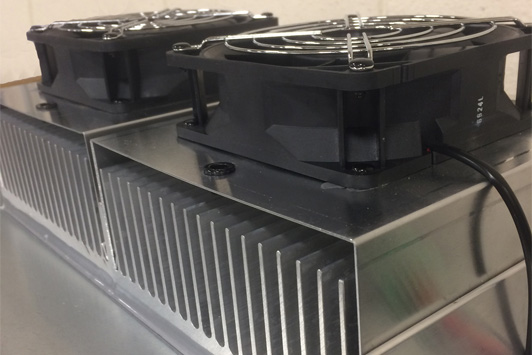
Darwin Chambers utilizes the PFTCU unit to minimize refrigerant and make quick compressor
swap-outs easy whenever possible. Our reach-ins eliminate the compressor entirely when
feasible with thermoelectric technology at moderate temperatures.
One of the more common refrigerants used is for environmental rooms is R-404a (44±2%
C2HF5 · 52±1% C2H3F3 ·4±2% C2H2F4). Its primary use is in medium to low temperature
applications. However, it is fairly high in GWP at 3,922. Another common refrigerant used in
the industry is R-134a (1,1,1,2-Tetrafluoroethane) for high temperature refrigeration. R-134a
has a GWP of 1300. Both of these have significantly higher GWP than proposed replacements,
but are much more safer and efficient.
Two proposed replacements are propane (R-290 with a GWP of 3) and ammonia (R-717 with a
GWP of 0). Flammability and exposure with these replacements is different from R-404a and R-134a and their use will be somewhat slow to be universally adopted.
In the meantime, manufacturers of refrigerants are coming out with better refrigerants that have a
lower GWP than R-404a and R-134a and better safety than ammonia and propane. HoneyWell
and DuPont, the largest refrigerant manufacturers, are introducing replacements such as R-448a.
R-448a has a 66% lower GWP than R-404a and similar efficiency with very few safety issues.
Commercial refrigeration of the future will certainly change.