Peptide therapeutics are highly sensitive to their environment. Temperature, humidity, formulation, packaging, and storage duration can all influence product stability, making it critical for pharmaceutical and biotechnology organizations to understand how a peptide may change throughout its lifecycle.
The challenge is time. Long-term stability studies can require months or years of observation before sufficient data becomes available. Accelerated stability testing helps researchers gain earlier insight by evaluating peptide products under controlled environmental stress.
By maintaining carefully defined temperature and relative humidity conditions, accelerated studies can help identify potential degradation pathways, compare formulations, evaluate packaging, and inform development decisions while long-term studies continue.
What Is Accelerated Stability Testing for Peptides?
Accelerated stability testing is the controlled exposure of a peptide drug substance or drug product to elevated environmental conditions to evaluate how its quality changes over time.
Rather than waiting for changes to occur under normal storage conditions, accelerated studies use environmental stress to increase the rate at which certain physical or chemical changes may occur.
For peptide development, accelerated stability testing can help researchers:
- Identify potential stability risks earlier
- Compare formulations and packaging configurations
- Evaluate degradation trends
- Support storage and handling decisions
- Generate supporting stability data during development
- Inform subsequent long-term stability studies
Accelerated testing complements rather than replaces long-term stability testing. The two approaches provide different information and are often used together as part of a broader stability program.
How Does Accelerated Stability Testing Work?
Accelerated stability testing places representative peptide samples in precisely controlled environmental conditions for a defined period. Researchers remove or evaluate samples at predetermined intervals and compare their critical quality attributes with baseline measurements.
A typical study involves four fundamental steps:
1. Define the Study Conditions
Researchers establish the temperature, relative humidity when applicable, study duration, sampling intervals, and acceptance criteria appropriate for the product and development stage.
The conditions should reflect the purpose of the study and applicable regulatory requirements rather than applying a single accelerated condition to every peptide product.
2. Maintain a Controlled Environment
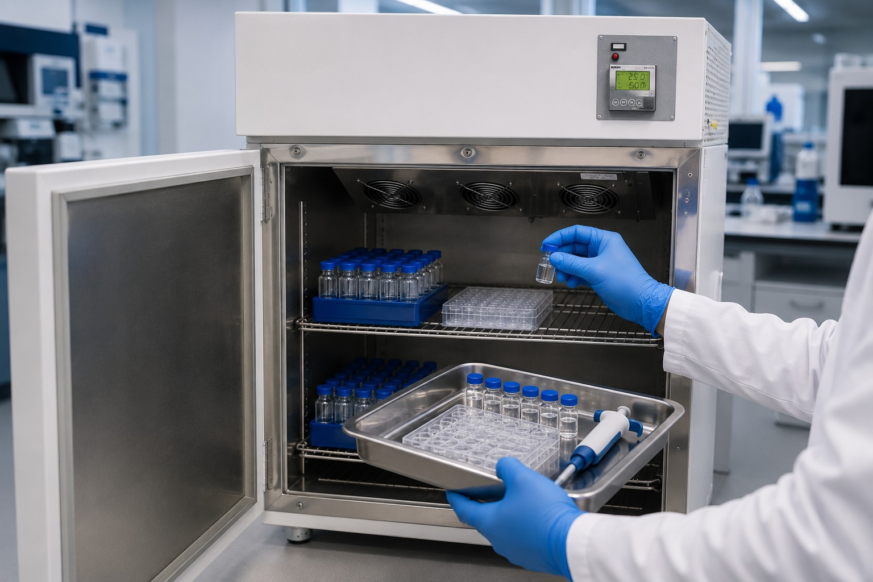
Samples are placed within a stability chamber capable of maintaining the specified environmental conditions throughout the study.
Consistent environmental control is essential. If temperature or humidity varies unexpectedly, researchers may have difficulty determining whether changes originated with the peptide product or the testing environment.
3. Evaluate Samples at Defined Intervals
Samples are tested at predetermined time points to identify physical or chemical changes.
Depending on the peptide and formulation, researchers may evaluate attributes such as:
- Potency
- Purity
- Degradation products
- Biological activity
- Appearance
- Moisture content
- Aggregation
- Container closure integrity
The specific analytical program depends on the product and study objectives.
4. Compare Results Over Time
Researchers analyze results across time points to identify trends and determine how the peptide responds to accelerated conditions.
These findings can help guide formulation development, packaging decisions, storage requirements, and the design of longer-term stability programs.
Why Is Accelerated Stability Testing Important for Peptides?
Peptides can be susceptible to multiple degradation pathways, and relatively small environmental changes may affect their stability.
Depending on the molecule and formulation, degradation mechanisms can include:
- Hydrolysis
- Oxidation
- Deamidation
- Aggregation
- Physical instability
- Loss of biological activity
Accelerated testing creates an opportunity to observe potential stability problems earlier in development.
For example, if one formulation demonstrates significantly greater degradation under accelerated conditions than another, researchers may be able to prioritize the more stable formulation for additional development.
The objective is not simply to make a peptide degrade faster. It is to generate useful information about how the product responds to environmental stress under controlled, repeatable conditions.
What Temperature and Humidity Conditions Are Used for Accelerated Peptide Stability Testing?
There is no universal accelerated stability condition appropriate for every peptide product.
Study conditions depend on factors including:
- Intended storage conditions
- Dosage form
- Formulation
- Packaging
- Development stage
- Applicable regulatory guidance
- Known temperature or moisture sensitivity
For pharmaceutical stability programs, study protocols may be informed by applicable ICH and regulatory guidance. The appropriate conditions should always be established based on the specific product and intended regulatory pathway.
This distinction is particularly important for peptides. Conditions appropriate for one formulation may produce limited or misleading information for another.
Accelerated vs. Long-Term Stability Testing for Peptides
Accelerated and long-term stability studies answer related but different questions.
| Accelerated Stability Testing | Long-Term Stability Testing | |
| Primary purpose | Generate earlier insight into stability behavior | Evaluate stability under intended storage conditions |
| Environment | Elevated or stressful conditions | Recommended long-term storage conditions |
| Timeline | Shorter | Longer |
| Development value | Identifies risks and supports earlier decisions | Establishes real-time stability performance |
| Common applications | Formulation comparison, packaging evaluation, degradation assessment | Shelf-life and storage-condition support |
| Relationship | Complements long-term testing | Provides long-term stability evidence |
Accelerated data can help inform development decisions sooner, but it should not automatically be interpreted as a direct substitute for real-time stability data.
When Should Accelerated Stability Testing Be Used?
Accelerated stability testing can provide value at several stages of peptide development.
Formulation Development
Researchers may use accelerated studies to compare candidate formulations and identify those that demonstrate greater stability under environmental stress.
This can help narrow formulation candidates before committing additional resources to longer-term studies.
Packaging and Container Closure Evaluation
Packaging can influence a peptide's exposure to moisture, oxygen, light, and other environmental factors.
Accelerated studies can help researchers compare packaging configurations and evaluate whether container closure systems adequately protect the product.
Storage Condition Development
Accelerated data can contribute to a broader understanding of temperature and humidity sensitivity.
Combined with other stability data, these findings can help inform appropriate storage, handling, and distribution strategies.
Development and Regulatory Stability Programs
Accelerated testing can provide useful supporting information while longer-term studies remain underway.
For regulated pharmaceutical and biotechnology applications, study design, chamber qualification, documentation, and environmental control should align with applicable requirements and the specific stability protocol.
Product or Process Changes
Changes to formulation, packaging, manufacturing processes, or other product characteristics may create new stability questions.
Accelerated studies can provide an early indication of whether those changes influence stability before longer-term data becomes available.
Why Environmental Control Matters in Accelerated Stability Testing
Accelerated stability studies deliberately introduce environmental stress. That makes control of the testing environment especially important.
A stability chamber must do more than reach a temperature and humidity setpoint. It must maintain consistent conditions throughout the usable storage space and across the duration of the study.
Reliable environmental control helps support:
- Temperature stability: minimizing fluctuations around the required setpoint
- Humidity stability: maintaining specified relative humidity where required
- Environmental uniformity: reducing differences between locations within the chamber
- Repeatability: supporting consistent conditions across studies and time
- Documentation: providing evidence that required conditions were maintained
The more precisely the environment is controlled, the greater the confidence researchers can have that observed changes are attributable to the samples rather than uncontrolled environmental variability.
Reach-In vs. Walk-In Stability Chambers for Peptide Testing
The appropriate chamber configuration often depends on sample volume, study scale, workflow, and future capacity requirements.
Reach-in stability chambers provide precise environmental control in a relatively compact footprint. They can be well suited to development laboratories, smaller stability programs, or organizations that need separate environments for multiple protocols.
Walk-in stability rooms provide substantially greater storage capacity and can support larger stability programs, higher sample volumes, and growing pharmaceutical operations.
Neither format is inherently better for peptide stability testing. The appropriate solution depends on the required conditions, capacity, qualification needs, facility constraints, and operational requirements.
Qualification and Monitoring for Regulated Stability Studies
For regulated stability programs, environmental performance must be demonstrated rather than assumed.
Depending on the application and applicable requirements, this can include:
- Installation Qualification (IQ)
- Operational Qualification (OQ)
- Performance Qualification (PQ)
- Temperature and humidity mapping
- Sensor calibration
- Continuous monitoring
- Alarm management
- Preventive maintenance
- Documented service and calibration records
Together, these practices help establish confidence that the chamber can maintain the environmental conditions required by the study protocol.
They also support a larger objective: protecting the integrity of the stability data generated inside the chamber.
Accelerated Stability Testing and Peptide Development
Accelerated stability testing can provide important early evidence, but its greatest value comes from its role within a broader stability strategy.
A peptide development program may combine accelerated testing with:
- Long-term stability testing
- Intermediate stability studies when appropriate
- Forced degradation studies
- Freeze-thaw studies
- Photostability testing when applicable
- Shipping and transportation studies
- Ongoing stability programs
Each study answers a different question.
Together, they help researchers build a more complete understanding of how a peptide product behaves from development through storage and eventual use.
Frequently Asked Questions About Accelerated Peptide Stability Testing
What is the purpose of accelerated stability testing for peptides?
Accelerated stability testing helps researchers evaluate how peptide products respond to elevated environmental conditions. It can identify potential degradation risks, compare formulations and packaging, and provide earlier stability information while long-term studies continue.
Does accelerated stability testing determine peptide shelf life?
Accelerated data can contribute to stability assessments, but it does not automatically replace long-term stability data. Shelf-life and expiration dating decisions depend on the complete stability program and applicable regulatory requirements.
Does every peptide use the same accelerated stability conditions?
No. Appropriate temperature, humidity, duration, and testing intervals depend on the peptide, formulation, packaging, intended storage conditions, development stage, and applicable regulatory guidance.
Why is humidity important in peptide stability testing?
Moisture can influence the stability of certain peptide formulations and dosage forms. When humidity is relevant to the study, precise relative humidity control helps ensure samples experience consistent and documented conditions.
What is the difference between accelerated stability testing and forced degradation testing?
Accelerated stability testing evaluates product behavior under elevated but controlled storage conditions over time. Forced degradation generally applies more severe stress to deliberately produce degradation and help characterize degradation pathways and analytical methods. They serve different purposes within pharmaceutical development.
Can accelerated peptide stability testing be performed in a refrigerator or cold room?
Standard refrigeration or cold storage is primarily designed to preserve products at lower temperatures. Accelerated stability studies require environmental conditions appropriate to the study protocol, which may include controlled temperature and relative humidity, environmental uniformity, monitoring, mapping, and qualification. A purpose-designed stability chamber is typically better suited to these requirements.
Precision Environmental Control for Peptide Stability Programs
Accelerated stability testing helps pharmaceutical and biotechnology organizations learn earlier, make better-informed development decisions, and identify potential stability risks before they become larger challenges.
The quality of that information depends in part on the consistency of the environment in which the study is conducted.
Darwin Chambers designs and supports precision-engineered reach-in chambers and walk-in environmental rooms for stability programs where performance, compliance, and reliability are critical. From controlled temperature and humidity to qualification and lifecycle support, Darwin Chambers helps organizations maintain dependable environments that protect research integrity and support confidence in stability data.
Planning an accelerated or long-term peptide stability program? Explore Darwin Chambers' peptide stability solutions or contact our team at sales@darwinchambers.com to discuss the environmental requirements for your application.
Additional Resources
Image Disclosure
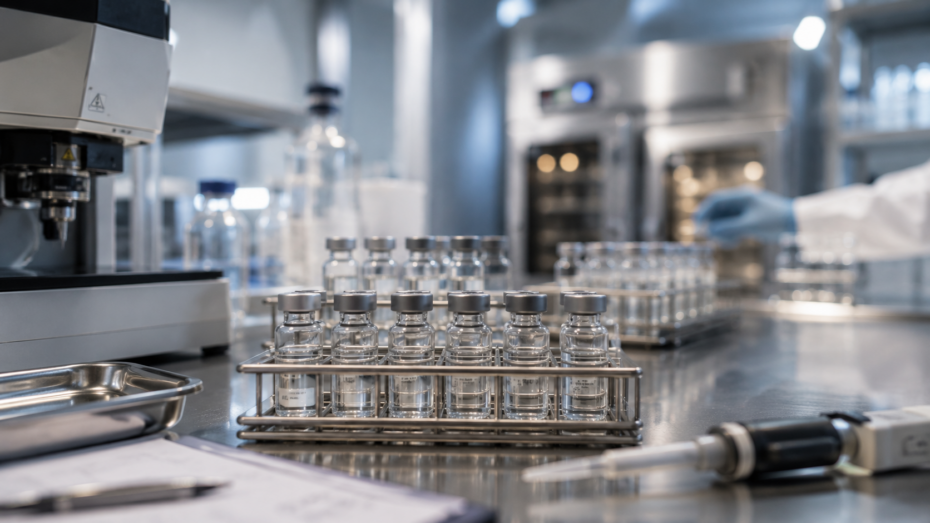
Visuals within this article include AI-generated illustrative concepts intended to represent controlled environment applications and operational scenarios. Images may not depict actual Darwin Chambers products, installations, or customer environments.