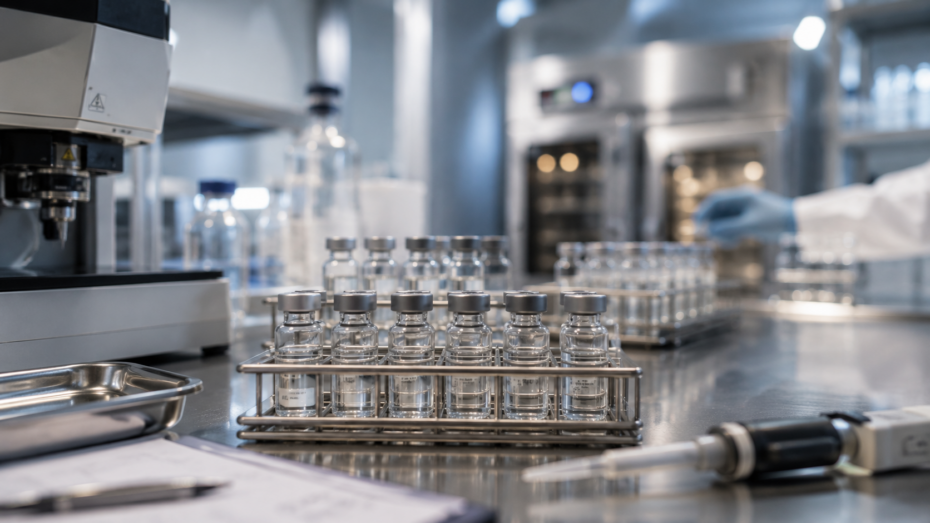
Environmental chambers are designed to create controlled conditions that support research, testing, storage, and manufacturing activities where precision is essential. Whether used for pharmaceutical stability studies, biotechnology research, product testing, or regulated storage, these chambers are expected to maintain consistent environmental conditions throughout the usable space.
But how do organizations verify that the temperature and humidity inside a chamber are truly uniform?
The answer is environmental chamber mapping.
Environmental mapping is a critical qualification activity used to evaluate chamber performance, identify environmental variations, and establish confidence in the chamber's ability to maintain controlled conditions.
What Is Environmental Chamber Mapping?
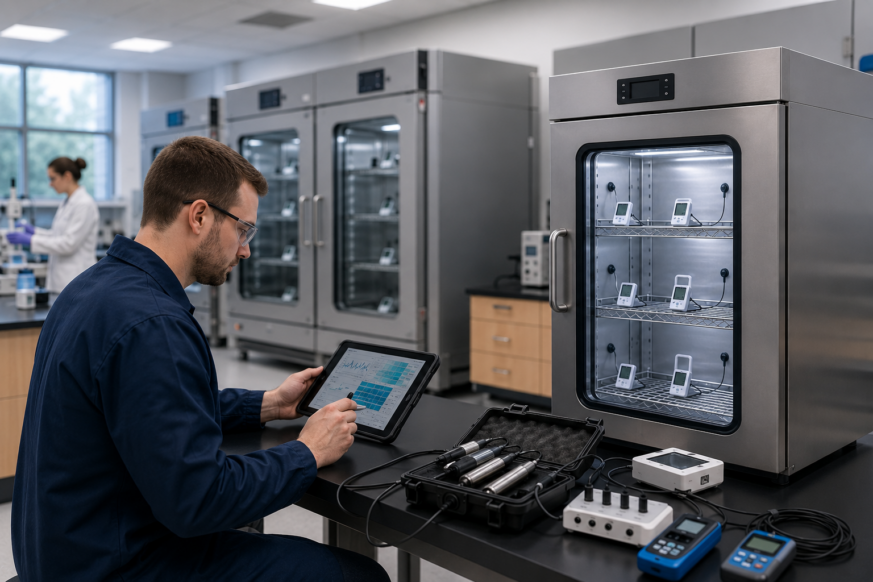
Environmental chamber mapping is the process of measuring and documenting environmental conditions throughout a chamber using multiple sensors placed in different locations.
The purpose is to determine how consistently the chamber maintains:
- Temperature
- Humidity
- Environmental stability
- Uniformity throughout the chamber
Mapping provides a detailed picture of chamber performance by identifying potential variations across the usable interior space.
Rather than relying on a single chamber sensor or controller reading, mapping evaluates environmental conditions throughout the entire chamber.
Why Is Environmental Mapping Important?
Environmental chambers rarely have perfectly identical conditions in every location.
Factors such as:
- Airflow patterns
- Shelf configurations
- Product loading
- Chamber size
- Mechanical system design
can create subtle environmental differences throughout the chamber.
Mapping helps organizations understand these variations and verify that conditions remain within acceptable limits.
This information supports confidence in the chamber's ability to protect research integrity, testing accuracy, and product quality.
What Does Environmental Mapping Measure?
The exact parameters measured depend on the chamber and application, but mapping commonly evaluates:
Temperature Uniformity
Temperature uniformity assesses how consistently temperature is maintained throughout the chamber.
During mapping, sensors are positioned throughout the interior to determine whether any locations experience significant variation compared to the desired setpoint.
Uniformity is particularly important for:
- Stability chambers
- Incubators
- Controlled storage environments
- Product testing applications
Humidity Uniformity
For chambers that control humidity, mapping may also evaluate humidity consistency across the chamber.
Humidity performance can be influenced by:
- Air circulation
- Chamber loading
- Environmental conditions
- Humidification system design
Mapping helps verify that humidity conditions remain consistent throughout the chamber.
Environmental Stability
Environmental stability evaluates how consistently conditions are maintained over time.
Even if a chamber achieves the desired temperature and humidity, fluctuations may occur due to operational or environmental factors.
Mapping helps quantify these variations and determine whether chamber performance meets established requirements.
How Is Environmental Chamber Mapping Performed?
While protocols vary depending on the application and regulatory requirements, the overall process generally follows a similar approach.
Step 1: Place Sensors Throughout the Chamber
Multiple calibrated sensors or data loggers are positioned throughout the chamber.
Common sensor locations include:
- Upper shelves
- Lower shelves
- Front locations
- Rear locations
- Corners
- Center positions
The goal is to evaluate conditions throughout the usable chamber volume.
Step 2: Stabilize the Chamber
The chamber is set to the desired environmental conditions and allowed to stabilize.
During this period:
- Chamber doors remain closed
- Environmental systems operate normally
- Conditions reach equilibrium
Stabilization helps ensure that data collection reflects normal operating performance.
Step 3: Collect Environmental Data
Sensors record environmental conditions over a defined period.
Data may be collected for:
- Several hours
- Multiple days
- Extended qualification periods
The duration depends on the application and qualification protocol.
Step 4: Analyze Results
Collected data is reviewed to evaluate:
- Temperature uniformity
- Humidity uniformity
- Environmental stability
- Performance trends
- Areas of environmental variation
Results are compared against predefined acceptance criteria.
Step 5: Document Findings
Mapping activities are documented as part of the qualification process.
Documentation typically includes:
- Sensor locations
- Environmental data
- Statistical analysis
- Acceptance criteria
- Conclusions and observations
This documentation provides evidence supporting chamber qualification and audit readiness.
What Are Hot Spots and Cold Spots?
One of the primary goals of mapping is identifying environmental variations often referred to as hot spots and cold spots.
A hot spot is an area where temperatures are consistently higher than surrounding locations.
A cold spot is an area where temperatures are consistently lower than surrounding locations.
These variations may result from:
- Airflow patterns
- Chamber design characteristics
- Product loading
- Shelving arrangements
Understanding these areas helps organizations make informed decisions about chamber use and product placement.
When Should Environmental Mapping Be Performed?
Environmental mapping is commonly performed:
- During Installation Qualification (IQ), Operational Qualification (OQ), and Performance Qualification (PQ) activities
- After new chamber installation
- Following major repairs
- After chamber relocation
- Following significant modifications
- During periodic requalification programs
Organizations often establish mapping frequencies based on operational requirements, quality systems, and regulatory expectations.
Mapping and Chamber Qualification
Environmental mapping is frequently a key component of chamber qualification programs.
It supports:
Operational Qualification (OQ)
Mapping helps verify that the chamber operates according to design specifications.
Performance Qualification (PQ)
Mapping demonstrates that the chamber performs consistently under actual operating conditions.
Together, qualification and mapping provide documented confidence in environmental chamber performance.
Mapping Does Not End With Qualification
Qualification and mapping provide valuable snapshots of chamber performance at a specific point in time.
However, chamber performance can change over time due to:
- Component aging
- Sensor drift
- Mechanical wear
- Environmental influences
- Operational changes
For this reason, many organizations combine periodic mapping with:
- Preventive maintenance
- Calibration programs
- Environmental monitoring
- Predictive monitoring technologies
This broader lifecycle approach helps maintain confidence in chamber performance between qualification events.
Common Applications for Environmental Mapping
Environmental mapping is widely used across regulated and controlled environments, including:
Pharmaceutical Stability Chambers
Verifying uniform conditions for long-term stability studies.
Biotechnology and Life Sciences
Supporting research environments where environmental consistency is essential.
Controlled Storage Rooms
Evaluating environmental conditions across larger storage spaces.
Incubators and Growth Chambers
Ensuring consistent conditions for biological and agricultural applications.
Product Testing Chambers
Supporting environmental simulation and validation programs.
Why Mapping Matters
Environmental chamber mapping provides far more than a collection of temperature and humidity readings.
It helps organizations answer critical questions:
- Are conditions uniform throughout the chamber?
- Can the chamber maintain environmental stability over time?
- Are there areas of environmental variation?
- Is chamber performance suitable for the intended application?
The answers to these questions help support quality, compliance, and confidence in the work being performed inside the chamber.
For regulated industries, environmental mapping plays an important role in protecting research integrity, product quality, and operational consistency.
A Partner in Performance
Darwin Chambers provides environmental chambers, qualification support, environmental mapping services, and lifecycle expertise designed to help organizations maintain confidence in chamber performance over time.
Because protecting controlled environments ultimately means protecting the work those environments support.
Learn More
If you would like to discuss environmental chamber mapping, qualification programs, or lifecycle chamber support, our team can help.
Contact sales@darwinchambers.com to learn more.
Image Disclosure
Visuals within this article include AI-generated illustrative concepts intended to represent controlled environment applications and operational scenarios. Images may not depict actual Darwin Chambers chambers, installations, or customer environments.