Bee and pollinator research presents a controlled-environment challenge unlike many traditional laboratory applications.
Researchers are not simply maintaining a sample at a specified temperature and humidity. They are working with living organisms whose activity, development, feeding, reproduction, and behavior can respond to their surroundings. In some cases, the bees themselves can even influence the conditions researchers are trying to control.
Creating an effective chamber for bee research therefore requires more than maintaining environmental setpoints. The environment needs to be engineered around the biology and behavior of the pollinator itself.
What Is a Controlled Environment Chamber for Bee Research?
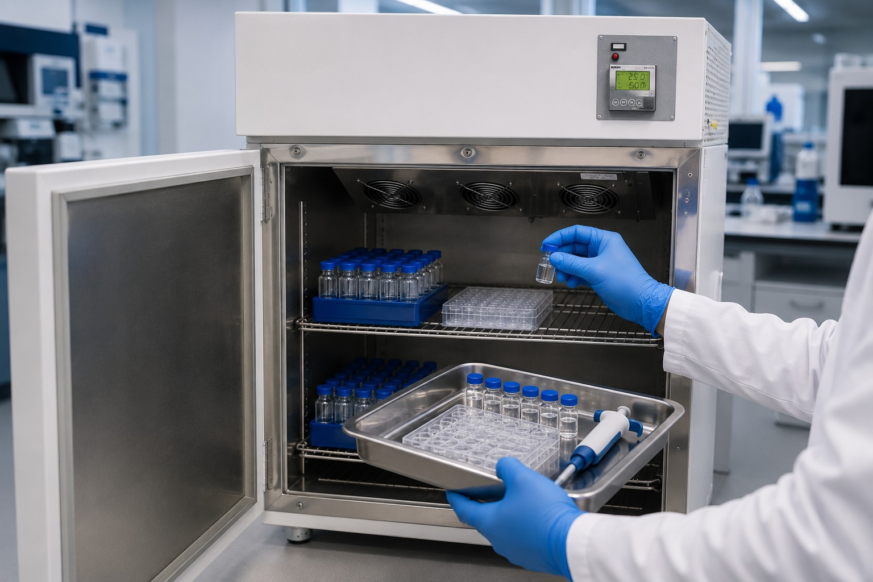
A controlled environment chamber for bee research is an enclosed research environment designed to maintain defined, repeatable conditions for studying bees and other pollinators.
Depending on the research protocol, controlled variables may include:
- Temperature
- Relative humidity
- Lighting
- Photoperiod
- Airflow and ventilation
- Environmental monitoring
- Data logging
The objective is to reduce uncontrolled environmental variability so researchers can more confidently evaluate the factors they intend to study.
What Makes Bee Research Chambers Different?
The Research Subjects Can Generate Heat
This is one of the most distinctive considerations in bee research.
Honey bee colonies actively regulate their thermal environment. Worker bees can generate metabolic heat through muscular activity, cluster in response to colder conditions, and use fanning and evaporative cooling when conditions become warmer. Maintaining appropriate brood temperatures is an important part of colony biology.
Inside a controlled research environment, that means the bees are not necessarily a passive chamber load.
They can become part of the thermal load themselves.
Depending on the species, population, experimental setup, and activity level, chamber design may therefore need to consider not only the desired ambient temperature but also heat being generated within the research environment.
Bees Can Influence Their Microenvironment
Heat is not the only consideration.
Bees respire, release CO₂, and interact continuously with their surroundings. Feeding systems, water, plants, research enclosures, colony size, and other experimental materials can further influence conditions within a chamber.
As the scale and complexity of the experiment increase, airflow, ventilation, humidity control, and chamber capacity can become increasingly important considerations.
The result is a dynamic relationship: the chamber influences the organisms, while the organisms can influence the chamber environment.
Airflow Requires Careful Consideration
Environmental chambers rely on air circulation to maintain uniform temperature and humidity. With living pollinators, however, airflow cannot be considered solely from the perspective of chamber performance.
Researchers may also need to consider how air movement interacts with bee enclosures, feeding systems, plants, experimental equipment, and the organisms themselves.
The objective is consistent environmental control without introducing unnecessary variability into the experiment.
Light Is More Than Illumination
Light and daily environmental cycles can influence bee activity and circadian behavior.
For controlled research, programmable lighting and photoperiod can therefore become experimental variables rather than simply features that allow researchers to see inside the chamber.
Precisely reproducing day/night cycles can help establish consistent conditions across experimental groups and repeated studies.
The Chamber Has to Fit the Experiment
Bee research can involve much more than placing specimens on a shelf.
A research environment may need to accommodate:
- Bee cages or specialized enclosures
- Feeding and watering systems
- Colony or group studies
- Observation equipment
- Environmental sensors
- Experimental plants
- Toxicology or exposure equipment
Smaller experiments may be well suited to reach-in chambers, while colony studies and more complex research programs may require larger walk-in controlled environments.
The right chamber should therefore start with the experimental protocol, not simply a predetermined chamber configuration.
Why Repeatability Matters in Pollinator Research
When studying living organisms, environmental variability can make results more difficult to interpret.
If temperature, humidity, airflow, or lighting changes unexpectedly, researchers introduce another potential variable into the experiment. And when the research subjects themselves can affect their surroundings, maintaining and documenting consistent environmental conditions becomes even more important.
A well-designed controlled environment allows researchers to establish defined conditions, reproduce them across experimental groups, monitor performance, and repeat protocols over time.
The chamber becomes part of the experimental methodology, not simply the space where the experiment occurs.
What Can Controlled Environments Support?
Controlled environments can support a wide range of bee and pollinator research, including:
- Pollinator health
- Behavior and activity
- Rearing and development
- Toxicology and exposure
- Climate and environmental response
- Agricultural research
- Colony studies
- Controlled feeding experiments
Each application can introduce different biological, environmental, and physical requirements.
Engineering the Environment Around the Science
There is no single ideal chamber configuration for every bee or pollinator study.
The right solution begins with understanding the organisms, research protocol, environmental variables, population or colony size, enclosures, equipment, monitoring requirements, and scale of the program.
Darwin Chambers develops precision-controlled reach-in chambers and walk-in research environments that can be configured around specialized bee and pollinator research. Temperature, humidity, lighting, photoperiod, airflow, monitoring, data logging, and other chamber capabilities can be considered together as part of the complete experimental environment.
Because with pollinator research, the organisms aren't simply exposed to the controlled environment. They can actively change it.
That makes controlling the environment an important part of controlling the experiment.
Explore Darwin Chambers' Bee & Pollinator Research Solutions
Additional Resources
Image Disclosure
Visuals within this article include AI-generated illustrative concepts intended to represent controlled environment applications and operational scenarios. Images may not depict actual Darwin Chambers products, installations, or customer environments.