Quick Answer
Environmental chamber mapping and qualification are not the same thing.
Mapping is a testing activity used to measure environmental conditions throughout a chamber, while qualification is the documented process of demonstrating that a chamber is properly installed, operates correctly, and is fit for its intended use.
In most regulated environments, mapping is performed as part of qualification. However, completing a mapping study alone does not qualify a chamber.
Mapping vs Qualification: At a Glance
| Environmental Chamber Mapping | Environmental Chamber Qualification |
| Measures temperature and humidity distribution | Verifies overall chamber fitness for use |
| Uses multiple sensors or data loggers | Includes IQ, OQ, and PQ activities |
| Identifies hot spots and cold spots | Evaluates installation, operation, and performance |
| Focuses on environmental uniformity | Focuses on compliance and documented performance |
| Produces mapping reports | Produces qualification documentation |
| Often performed during OQ or PQ | Includes mapping as one component |
The easiest way to think about it is:
Mapping evaluates environmental performance. Qualification evaluates the entire system.
What Is Environmental Chamber Mapping?
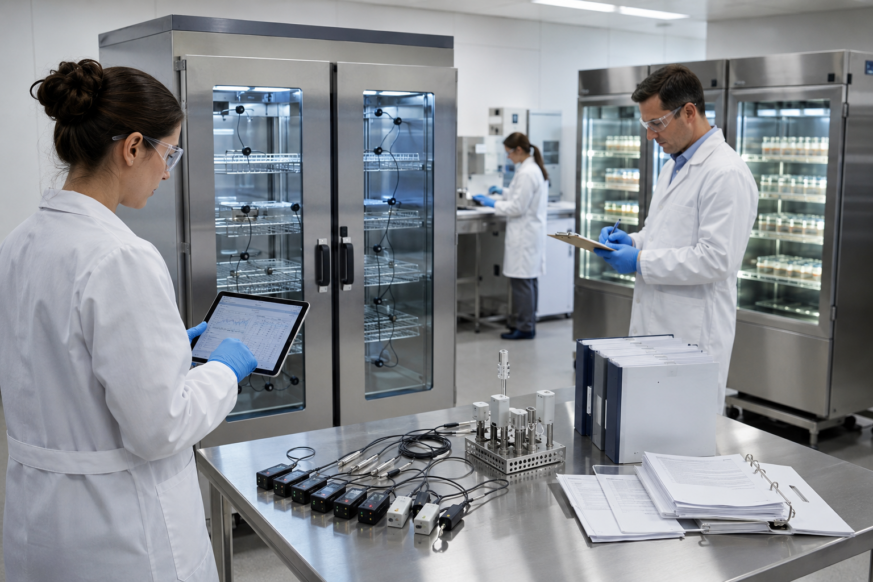
Environmental chamber mapping is the process of placing multiple calibrated sensors throughout a chamber to measure environmental conditions across the usable space.
The purpose of mapping is to determine whether the chamber can maintain consistent conditions throughout the storage or testing area.
A mapping study typically evaluates:
- Temperature uniformity
- Humidity uniformity
- Airflow distribution
- Hot spots and cold spots
- Chamber recovery after door openings
- Stability over time
The resulting data helps organizations understand how environmental conditions vary throughout the chamber and identify the locations most suitable for critical products or test samples.
Why Mapping Matters
Environmental conditions inside a chamber are rarely identical at every location.
Factors such as airflow patterns, shelving configurations, product loads, and chamber size can create small variations throughout the space.
Mapping helps organizations:
- Verify chamber performance
- Identify usable storage locations
- Support regulatory compliance
- Reduce risk to products and research materials
- Establish confidence in environmental control
For many pharmaceutical, biotechnology, healthcare, and research applications, mapping is a critical component of chamber validation programs.
What Is Environmental Chamber Qualification?
Environmental chamber qualification is the documented process used to verify that a chamber is capable of consistently performing its intended function.
Qualification evaluates far more than environmental uniformity alone.
The process typically includes three phases:
Installation Qualification (IQ)
Installation Qualification verifies that the chamber has been installed correctly according to manufacturer specifications and facility requirements.
IQ commonly includes:
- Equipment verification
- Utility verification
- Safety system review
- Documentation review
- Calibration verification
- Installation records
Operational Qualification (OQ)
Operational Qualification verifies that the chamber operates as intended across its specified operating ranges.
OQ often includes:
- Temperature testing
- Humidity testing
- Alarm testing
- Controller verification
- Recovery testing
- Environmental mapping
Many organizations perform their initial chamber mapping during OQ activities.
Performance Qualification (PQ)
Performance Qualification demonstrates that the chamber performs effectively under actual operating conditions.
PQ may include:
- Product loading studies
- Stability study simulations
- Process verification
- Long-term performance testing
The goal is to demonstrate that the chamber can consistently support its intended application.
Is Mapping Part of Qualification?
Yes.
In most regulated environments, mapping is performed as part of qualification.
Mapping provides objective evidence that environmental conditions remain consistent throughout the chamber and meet performance requirements.
Without mapping, organizations may have limited visibility into how conditions vary across the chamber's usable space.
However, mapping represents only one portion of the overall qualification process.
Can a Chamber Pass Mapping but Fail Qualification?
Yes.
A chamber may demonstrate acceptable temperature and humidity uniformity during mapping but still fail qualification for other reasons.
Examples include:
Calibration deficiencies
- Alarm failures
- Improper installation
- Documentation gaps
- Controller issues
- Safety system failures
Qualification evaluates the chamber as a complete system, not just its environmental performance.
This is one of the most important distinctions between mapping and qualification.
When Is Mapping Required?
Organizations commonly perform mapping:
- During initial qualification
- During chamber requalification
- After major repairs
- After relocation
- Following controller upgrades
- Following refrigeration system replacement
- As part of periodic quality programs
The specific frequency depends on industry requirements, quality procedures, and risk assessments.
When Is Qualification Required?
Qualification is commonly required when:
- Installing a new chamber
- Supporting GMP operations
- Conducting stability studies
- Preparing for regulatory inspections
- Supporting FDA-regulated activities
- Demonstrating equipment suitability
- Implementing new testing programs
Qualification provides documented evidence that the chamber can reliably support critical processes and research activities.
Why Understanding the Difference Matters
Organizations that confuse mapping and qualification often assume that a successful mapping study automatically qualifies a chamber.
In reality, qualification is a much broader process.
Mapping helps answer:
"Can this chamber maintain consistent environmental conditions throughout the space?"
Qualification answers:
"Can this chamber reliably support its intended application while meeting quality and compliance requirements?"
Both are important, but they serve different purposes.
Frequently Asked Questions
In most regulated applications, mapping is performed as part of qualification because it provides documented evidence of environmental uniformity and chamber performance.
While requirements vary by application, mapping is widely considered a best practice and is commonly included within qualification protocols to support performance verification.
Many organizations perform remapping during scheduled requalification activities, after major repairs, after relocation, or following significant system changes.
FDA regulations do not specifically prescribe chamber mapping procedures. However, organizations must demonstrate that equipment is suitable for its intended use, and mapping is commonly used to provide supporting evidence.
IQ verifies installation, OQ verifies operation, and PQ verifies performance under intended use conditions. Mapping is commonly performed during OQ and may also support PQ activities.
The Bottom Line
Environmental chamber mapping and qualification are closely related, but they are not interchangeable.
Mapping evaluates how environmental conditions are distributed throughout a chamber. Qualification verifies that the chamber, as a complete system, is properly installed, operating correctly, and capable of supporting its intended application.
For organizations operating in regulated environments, understanding the distinction helps reduce risk, strengthen compliance programs, and ensure confidence in chamber performance.
Related Resources
Why the Difference Matters for Long-Term Chamber Performance
Understanding the distinction between mapping and qualification helps organizations make more informed decisions about environmental chamber performance, compliance, and risk management.
Many chamber owners assume that a successful mapping study confirms their equipment is fully qualified. In reality, mapping provides valuable insight into environmental uniformity, while qualification provides documented evidence that the entire chamber system is capable of supporting its intended application.
Organizations that maintain a structured qualification program are often better positioned to:
- Reduce compliance risk
- Support regulatory inspections
- Protect valuable products and research materials
- Identify performance concerns before they impact operations
- Maintain confidence in environmental control between qualification intervals
Whether supporting pharmaceutical stability studies, research applications, archival preservation, or product testing, both mapping and qualification play an important role in ensuring reliable chamber performance.
Darwin Chambers: Your Partner in Performance
At Darwin Chambers, we understand that chamber performance extends far beyond installation day.
Our team supports organizations throughout the entire chamber lifecycle, including qualification, mapping, preventive maintenance, calibration support, performance evaluations, and long-term environmental control strategies.
From small reach-in chambers to large walk-in and transportable environments, our experts help customers establish confidence that their chambers are operating as intended and continue to support critical applications over time.
As regulatory expectations evolve and operational demands increase, organizations need more than equipment. They need a trusted partner committed to performance, reliability, and long-term success.
Need Help with Chamber Qualification or Mapping?
Whether you're commissioning a new chamber, preparing for requalification, investigating performance concerns, or planning a chamber expansion, Darwin Chambers can help.
Our team can assist with:
- Chamber qualification support
- Temperature and humidity mapping
- Chamber performance assessments
- Preventive maintenance programs
- Calibration and validation planning
- Environmental chamber modernization strategies
Contact Darwin Chambers to discuss your application and learn how our team can help support the performance, compliance, and longevity of your controlled environment equipment.
Image Disclosure
Visuals within this article include AI-generated illustrative concepts intended to represent controlled environment applications and operational scenarios. Images may not depict actual Darwin Chambers chambers, installations, or customer environments.