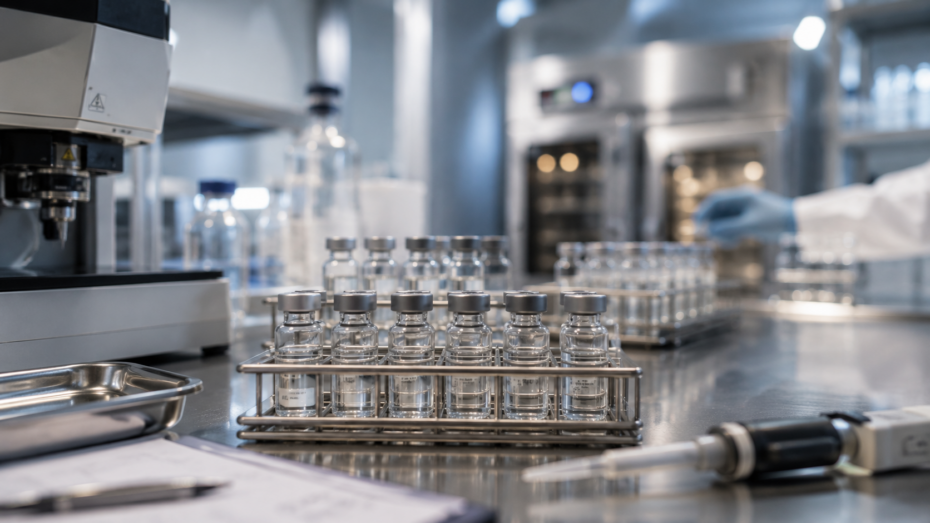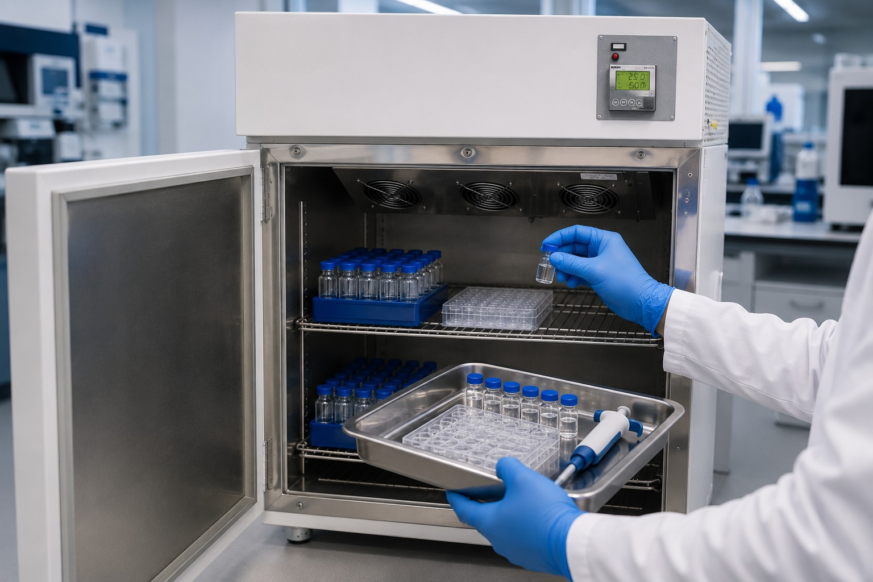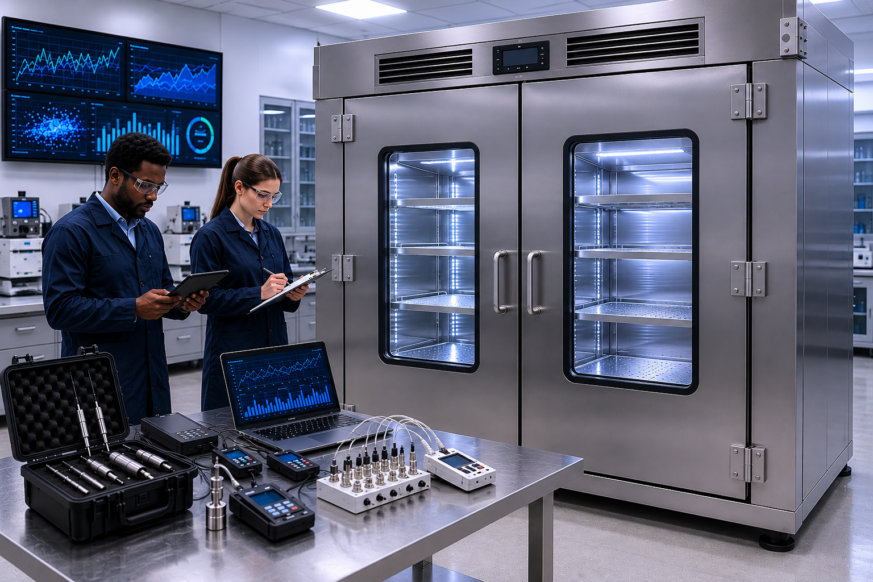
Environmental chambers play a critical role in pharmaceutical manufacturing, biotechnology, life sciences, medical devices, and other regulated industries where environmental control directly impacts product quality, testing accuracy, and research integrity.
Installing an environmental chamber is only one part of the process. Organizations must also verify that the chamber performs as intended and can consistently maintain the required environmental conditions over time.
This is where qualification becomes essential.
The qualification process is commonly divided into three phases:
- Installation Qualification (IQ)
- Operational Qualification (OQ)
- Performance Qualification (PQ)
Together, these activities help demonstrate that an environmental chamber has been properly installed, operates according to specifications, and performs reliably within its intended application.
What Is Environmental Chamber Qualification?
Qualification is a documented process used to verify that an environmental chamber is suitable for its intended use.
In regulated industries, qualification helps support:
- Product quality
- Research integrity
- Regulatory compliance
- Audit readiness
- Risk reduction
Qualification provides evidence that the chamber can consistently achieve and maintain required environmental conditions.
While specific requirements vary by industry and application, IQ, OQ, and PQ form the foundation of most qualification programs.
Why IQ, OQ, and PQ Matter
Environmental chambers support applications where temperature, humidity, and environmental consistency can directly affect outcomes.
Examples include:
- Pharmaceutical stability studies
- Biological sample storage
- Medical device testing
- Controlled research environments
- Manufacturing support processes
Without qualification, organizations may have limited documented evidence that environmental conditions are being maintained as intended.
Qualification helps ensure that chamber performance supports both operational requirements and quality objectives.
What Is Installation Qualification (IQ)?
Installation Qualification verifies that the chamber has been installed correctly according to approved specifications and manufacturer requirements.
IQ is typically performed after installation and before operational testing begins.
The objective is to confirm that all required components, utilities, documentation, and installation conditions are in place.
Typical IQ Activities
Installation Qualification may include:
- Verification of chamber model and configuration
- Utility connection verification
- Electrical system inspection
- Review of installation documentation
- Verification of safety systems
- Inspection of chamber components
- Review of operating manuals and documentation
The focus of IQ is not how the chamber performs.
The focus is confirming that the chamber has been installed correctly and is ready for operational testing.
What Is Operational Qualification (OQ)?
Operational Qualification verifies that the chamber operates according to its design specifications.
OQ evaluates whether chamber systems function properly across intended operating ranges.
This phase often includes testing temperature, humidity, controls, alarms, and other critical functions.
Typical OQ Activities
Operational Qualification may include:
- Temperature performance testing
- Humidity performance testing
- Alarm verification
- Controller verification
- Recovery testing
- Safety system testing
- Sensor verification
OQ demonstrates that the chamber is capable of producing the environmental conditions required by the application.
The chamber is tested against predefined acceptance criteria and documented performance requirements.
What Is Performance Qualification (PQ)?
Performance Qualification verifies that the chamber performs consistently under actual or simulated operating conditions.
While IQ confirms proper installation and OQ confirms proper operation, PQ focuses on real-world performance.
The objective is to demonstrate that the chamber can reliably support its intended use over time.
Typical PQ Activities
Performance Qualification may include:
- Loaded chamber testing
- Environmental mapping
- Stability evaluation
- Uniformity assessment
- Recovery analysis
- Application-specific performance testing
PQ often reflects how the chamber will actually be used in day-to-day operations.
This makes it one of the most important qualification phases for many regulated applications.
Understanding Environmental Mapping
Environmental mapping is frequently performed during OQ and PQ activities.
Mapping evaluates environmental conditions throughout the chamber to identify:
- Temperature uniformity
- Humidity uniformity
- Hot spots
- Cold spots
- Airflow-related variations
Multiple sensors are placed throughout the chamber to collect data over a defined period.
Mapping helps verify that environmental conditions remain consistent across the usable chamber space.
For many applications, environmental mapping provides critical evidence supporting qualification and ongoing chamber performance.
IQ vs OQ vs PQ: What's the Difference?
A simple way to think about qualification is:
| Qualification Phase | Primary Question |
| IQ | Was the chamber installed correctly? |
| OQ | Does the chamber operate correctly? |
| PQ | Does the chamber perform reliably for its intended use? |
Each phase builds upon the previous phase.
Together they provide documented evidence that the chamber is suitable for supporting critical work.
When Should Qualification Be Performed?
Qualification is commonly performed:
- After initial installation
- Following major repairs
- After significant modifications
- During chamber relocation
- When required by quality systems
- Following certain maintenance activities
Organizations should establish qualification requirements based on their specific application, quality standards, and regulatory expectations.
Qualification and Regulatory Compliance
While qualification requirements vary across industries, IQ, OQ, and PQ are widely recognized as foundational elements of quality and validation programs.
Qualification activities help organizations support:
- Good Manufacturing Practices (GMP)
- Stability programs
- Validation activities
- Internal quality systems
- Audit readiness
Qualification provides documented evidence that environmental conditions are being maintained in a controlled and repeatable manner.
Qualification Is Not a One-Time Event
Many organizations view qualification as part of a broader lifecycle approach to chamber performance.
Over time, factors such as:
- Component wear
- Sensor drift
- Environmental changes
- System modifications
can affect chamber performance.
For this reason, organizations often combine qualification with:
- Preventive maintenance
- Calibration programs
- Environmental monitoring
- Periodic requalification
The goal is maintaining confidence in chamber performance throughout its operational life.
The Role of Monitoring Between Qualifications
Qualification provides a snapshot of chamber performance at a specific point in time.
Increasingly, organizations are looking for additional visibility between qualification events.
Continuous monitoring and predictive monitoring technologies can help identify:
- Performance drift
- Environmental instability
- Abnormal operating behavior
- Early indicators of component wear
These insights help organizations maintain awareness of chamber health between qualification activities.
Monitoring does not replace qualification.
Instead, it complements qualification by providing ongoing visibility into environmental performance.
Building Confidence in Chamber Performance
Qualification is ultimately about more than compliance.
It is about creating documented confidence that environmental chambers can reliably support the work they were designed to protect.
Whether supporting stability studies, research programs, testing activities, or controlled storage environments, IQ, OQ, and PQ help establish a foundation for long-term environmental reliability.
Organizations that approach qualification as part of a broader lifecycle strategy are often better positioned to reduce risk, support quality objectives, and protect research integrity over time.
A Partner in Performance
Darwin Chambers provides environmental chambers, qualification support, and lifecycle services designed to help organizations maintain confidence in environmental performance across research, testing, storage, and regulated applications.
Because protecting chamber performance ultimately means protecting the work inside the chamber.
Learn More
If you would like to discuss chamber qualification, environmental mapping, preventive maintenance, or long-term chamber support, our team can help.
Contact sales@darwinchambers.com to learn more.
Image Disclosure
Visuals within this article include AI-generated illustrative concepts intended to represent controlled environment applications and operational scenarios. Images may not depict actual Darwin Chambers chambers, installations, or customer environments.