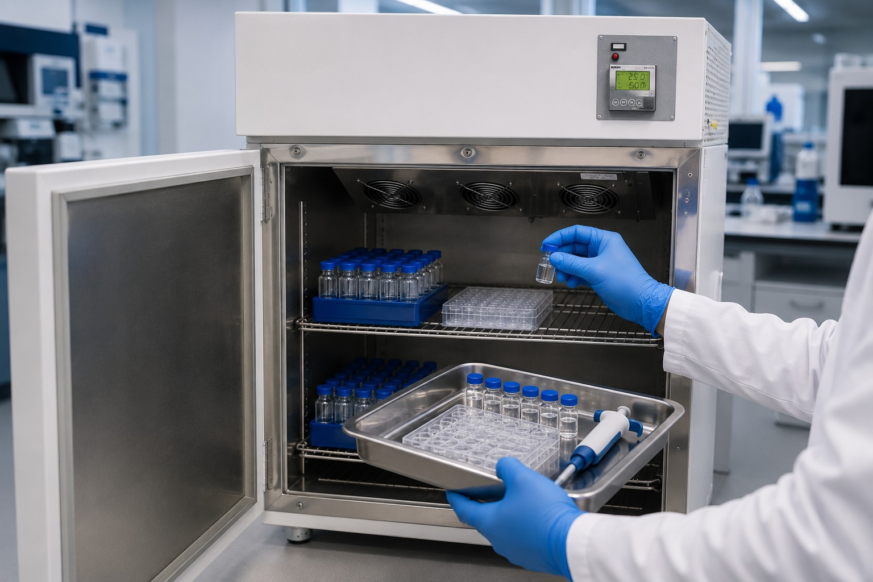
Environmental chambers are essential tools for research, testing, and controlled storage across a wide range of industries. One of the most important decisions when selecting a chamber is choosing between a walk-in and a reach-in configuration.
Each serves a distinct purpose, and selecting the right type can directly impact efficiency, scalability, and long-term performance.
This guide breaks down the key differences, use cases, and considerations to help determine which solution best fits your application.
What Is the Difference Between Walk-in and Reach-in Environmental Chambers?
The primary difference comes down to size, access, and application scale.
- Walk-in environmental chambers are large, room-sized environments that allow personnel to enter and work inside.
- Reach-in environmental chambers are smaller, self-contained units accessed through doors or panels without entering the chamber.
Both are designed to maintain precise environmental conditions, but they support very different operational needs.
What Is a Walk-in Environmental Chamber?
Walk-in environmental chambers are engineered spaces that provide controlled conditions at a larger scale.
Key Characteristics
- Large interior volume
- Full personnel access
- Custom configurations based on application
- Designed for long-duration or high-volume use
Common Use Cases
- Large-scale stability studies
- Environmental simulation for equipment or systems
- Storage of bulk materials or samples
- Testing that requires in-chamber setup or interaction
Walk-in chambers are often used when space, scale, or direct access is required to support the work being performed.
What Is a Reach-in Environmental Chamber?
Reach-in chambers are compact units designed for precision testing and research in laboratory settings.
Key Characteristics
- Smaller footprint
- Front-access doors or compartments
- Standardized or semi-custom configurations
- Ideal for controlled, repeatable testing
Common Use Cases
- Laboratory research and development
- Product testing and validation
- Short- to mid-term studies
- Controlled storage for smaller sample sets
Reach-in chambers are best suited for environments where space efficiency and precise control are priorities.
Walk-in vs Reach-in: Key Differences
| Feature | Walk-in Chambers | Reach-in Chambers |
| Size | Large, room-scale | Compact, lab-scale |
| Access | Personnel can enter | Access via doors |
| Capacity | High-volume | Limited capacity |
| Customization | Highly customizable | More standardized |
| Use Duration | Long-term studies | Short- to mid-term testing |
| Space Requirements | Requires dedicated space | Fits within lab environments |
How to Choose the Right Environmental Chamber
Selecting between walk-in and reach-in chambers depends on how the chamber will be used over time.
1. Scale of Operation
If your application involves:
- Large sample volumes
- Full equipment setups
- Multiple simultaneous studies
A walk-in chamber is typically the better choice.
For smaller-scale testing or limited sample sizes, a reach-in chamber is often more efficient.
2. Access Requirements
If your process requires:
- Frequent interaction inside the chamber
- Physical setup or adjustments during testing
A walk-in chamber provides the necessary accessibility.
If interaction is minimal and samples can be placed and removed externally, a reach-in chamber is sufficient.
3. Available Space
Facility constraints play a major role.
- Walk-in chambers require dedicated space and installation planning
- Reach-in chambers can be integrated into existing lab environments
4. Study Duration and Workflow
Long-duration studies or continuous storage environments often benefit from walk-in configurations.
Shorter tests, iterative research, and development cycles are typically better suited for reach-in chambers.
5. Customization Needs
Walk-in chambers offer greater flexibility for:
- Unique dimensions
- Specialized configurations
- Complex environmental requirements
Reach-in chambers are often standardized, which can reduce cost and simplify deployment.
When Organizations Use Both
In many cases, organizations use both chamber types together.
For example:
- Reach-in chambers for early-stage testing and development
- Walk-in chambers for scale-up, validation, or long-term studies
This combination allows teams to match the environment to the stage of work, improving efficiency and consistency.
Why the Right Choice Matters
Choosing the correct chamber is not just a matter of size.
It affects:
- Workflow efficiency
- Study reliability
- Space utilization
- Long-term operational costs
More importantly, it impacts the ability to maintain consistent environmental conditions, which is critical for producing accurate, repeatable results.
In many applications, the value of the research or materials inside the chamber far exceeds the equipment itself. Ensuring the right configuration helps protect that work from unnecessary risk.
A Partner in Performance
Whether walk-in or reach-in, environmental chambers must deliver precision, consistency, and reliability over time.
Darwin Chambers works with organizations to design and support controlled environments that align with specific applications, regulatory requirements, and long-term performance needs.
Because selecting the right chamber is not just about meeting today’s requirements.
It’s about supporting the work that depends on it.
Learn More
If you are evaluating walk-in or reach-in environmental chambers, or determining which solution best fits your application, our team can help.
Contact sales@darwinchambers.com to discuss your requirements and explore options.
Image Disclosure
Visuals within this article include AI-generated illustrative concepts intended to represent controlled environment applications and operational scenarios. Images may not depict actual Darwin Chambers chambers, installations, or customer environments.